
Do nothing
Sometimes the best thing you can do is absolutely nothing.

Try this. Simple lifestyle changes that can have profound effects on our mental and physical health. Some may work for you, some may not. There's only one way to find out.
In the book Zen in the Martial Arts, the author tells a story about trying to arrange a meeting with his teacher. He suggested a time, and the teacher replied, “I can’t do that, I’m doing nothing that day.”
The author was confused. “If you’re not doing anything, why can’t we meet?”
The teacher responded, “I didn’t say I wasn’t doing anything, I said I was doing nothing.”
It took me a long time to really understand the difference between not doing anything and doing nothing. It took me even longer to understand the importance of doing nothing. Years of working in tech startups conditioned me to believe that I should be busy every single minute of every single day.
That attitude nearly killed me. I burned out so badly that I ended up in hospital. Twice.
Taking time out to do nothing isn’t a waste of time. It’s essential maintenance for your mind and body. And the more busy and stressed you are, the more important it is to make time to take a break.1
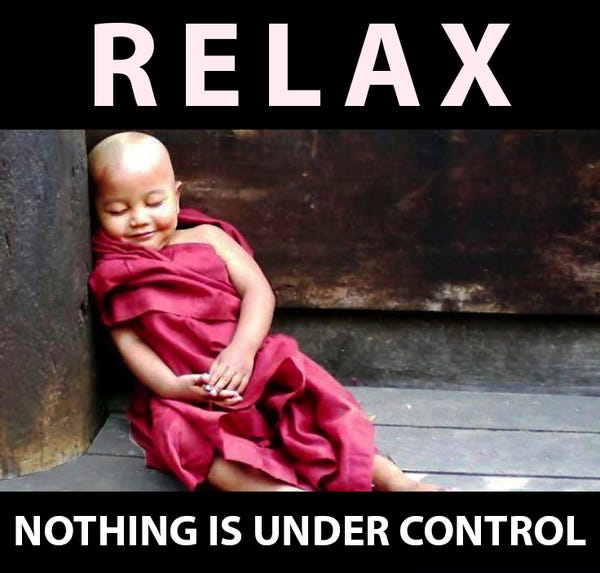
Five minutes of nothing
This is probably the simplest exercise imaginable. Find a comfortable place to sit, shut your eyes, breathe slowly and deeply, and chill.2
You don't have to do lotus position or anything fancy like that. Sit wherever feels best to you: in a chair, on the floor, on a cushion: it really doesn’t matter. Or lie down if you prefer (though this might be tricky if you’re doing it in an office). If the weather’s nice, I like to do this standing outside on my deck.
Just for a few minutes, focus on nothing else except your breath going in and out. Don't think about your to do list, the news, the family, what you’re going to make for dinner, or anything else. Just breathe.
What exactly do I do for five whole minutes?
I like to use a technique called box breathing: it’s a super simple regular sequence that works like this.3
Breathe in for a count of four.
Hold for a count of four.
Breathe out for a count of four.
Hold for a count of four.
Repeat.
If you’re counting at roughly one count per second, your breathing rate will be about four breaths per minute. That’s probably about a quarter of your normal breathing rate. After a few minutes of this, you’ll find that your heart rate has dropped noticeably: typically, mine will go from 78 to about 64 within five minutes.
Note: I don’t recommend using a timer, metronome, app or background music to help you keep the time. This exercise is much more effective if you count the breaths in your head. Actively counting means that you’re focusing on keeping your breath rhythmical, which means you’re less likely to be distracted by all the other things swirling around in your head.
You don’t have to be accurate, and it’s fine to vary the counting speed if you want to: there’s nothing magical about a four-second count. Counting slower will help you deepen the breath and intensify the effect. Or just increase the count: I often find myself switching to a count of six, or even eight.
But I keep thinking about stuff…
Yep, and that’s totally normal. Trying to think about nothing is about as easy as not thinking of a white bear. You just can’t do it. Your mind will start drifting off onto all those other things. So when you catch yourself doing it, don’t stress about it. Just go back to counting your breath: in, hold, out, hold, repeat...
And if your mind keeps going back to one thing, let it. I often find that five minutes of sitting quietly is a great way to get clarity on something that’s been bugging me, solve a problem, or plan the rest of my day. (That’s not how meditation is supposed to work, but it works for me!)
Feel the power of nothing
There are literally hundreds of studies that prove that just five minutes of doing nothing reduces your blood pressure and cortisol, and increases serotonin and oxygen levels.4 That has all sorts of short-term and long-term beneficial effects:5
It reduces stress and anxiety.
It boosts your immune system.
It reduces fatigue.
It improves cognition and problem-solving ability..
It improves your concentration and alertness.
It gives your brain an opportunity to process experiences you’ve had earlier in the day, which improves short-term memory.
It can increase your creativity.
It can improve your sleep.
It gives you an opportunity to disconnect from unwelcome thoughts and stressful situations.
It makes it easier to context switch and move from one task to another.
It helps you to develop an attitude of self-care.
Stepping away from screens and phones reduces overstimulation.
That’s pretty impressive for something that takes just a few minutes, is completely free, and involves no drugs or special equipment!
And of course, it’s an exercise you can fit in pretty much anywhere, any time, as many times a day as you want. Do it while you’re waiting for your coffee to brew. Do it in in between Zoom calls. Do it in the car in the parking lot when you get to work. On your lunch break. Last thing at night. Whenever you can.6
So when it all gets too much, just do nothing for a few minutes. It feels great.7
I'm not a doctor, dietitian, nutritionist, therapist, psychologist, psychiatrist, meditation trainer, yoga teacher, or anything else. My academic background is in anthropology, and I've taken some neuroscience and NLP courses, but otherwise I'm self-educated. Nothing in this blog constitutes professional advice.
“The key to being mentally sharp, productive, and emotionally healthy is to allow your brain time to rest.” The Benefits of Doing Nothing, INSEAD.
I highly recommend these two books on breathwork: The Breathwork Companion, by Margaret Townsend, and How to Calm Down: Three Deep Breaths to Peace of Mind, by Fred Miller. They’re both practical books, not filled with esoteric mumbo-jumbo.
Box breathing is a well-known technique. It’s been a standard yogic practice, sama vritti pranayama, for centuries. Even Navy SEALs use it to calm themselves in stressful situations. How Box Breathing Can Help You Destress, Cleveland Clinic, 2021.
For example, see Physiology of long pranayamic breathing: neural respiratory elements may provide a mechanism that explains how slow deep breathing shifts the autonomic nervous system, and The Effect of Diaphragmatic Breathing on Attention, Negative Affect and Stress in Healthy Adults, National Library of Medicine.
“Even 2 to 5 minutes a day can have an impact, helping you recharge and power through the rest of your day.” 6 Health Benefits Of Taking Time To Do Nothing, Henry Ford Health, 2022.
One little trick I learned when I was quitting smoking was that five minutes of nothing takes the same length of time as smoking a cigarette. So instead of a cigarette break, I’d take a nothing break. I still do.
As Winnie the Pooh says, “Doing nothing often leads to the very best something.” My mum always used to say that she learned a lot from Pooh, even before The Tao of Pooh came out! The older I get, the more I realize she was right. See. Pressing Pause: 10 Surprising Benefits of Doing Nothing, ImprovementSavvy